Consistent table service does not come from asking stewards to “be attentive”. It comes from teaching a visible sequence, practising it during quiet hours and checking it on every shift. This matters especially in Hyderabad outlets where weekday corporate lunches in HITEC City, evening café traffic in Jubilee Hills and crowded brewery weekends in Financial District require different pacing. A useful training system gives stewards clear actions while allowing supervisors to correct performance objectively.
Define One Service Sequence
Write the complete table-service sequence on a single page, using the actual steps followed in your outlet. It should cover greeting, seating assistance, water, menu presentation, order taking, table checks, clearance, dessert or beverage prompts, billing and farewell. Specify timing only where the team can control it. For example, a steward can greet promptly and repeat an order immediately, but cannot guarantee a kitchen preparation time without confirmation.
Train the sequence by service format rather than copying a luxury-hotel script. A Madhapur café may need counter-order guidance and laptop-friendly table awareness, while a brewery in Gachibowli needs age-verification escalation, drink identification and careful glass clearance. Demonstrate each step at a real table with the outlet’s menus, trays, crockery and point-of-sale workflow. Stewards should see the expected standard before being asked to reproduce it.
Make Order Accuracy Observable
Many service errors begin because the steward appears to understand an order but does not confirm its details. Teach a fixed repeat-back: item, quantity, variant, modification and course timing. For a group table, seat numbers or clear guest descriptions should be entered consistently. Avoid informal memory systems such as “the person in blue”, which become unreliable when guests move. Any unavailable item should be communicated before the order is sent, not when another dish reaches the table.
Build escalation language into training. A steward should know what to say when asked about allergens, alcohol ingredients, preparation methods or a discount they cannot authorise. “I will confirm that with my supervisor” is safer than guessing. In Hyderabad’s multilingual dining environment, simple English, Hindi or Telugu may help communication, but the point-of-sale entry must use the outlet’s standard item names and modifiers so that kitchen, bar and billing teams receive the same information.
- Repeat every modification to the guest
- Mark seat positions before sending orders
- Confirm unavailable items with the kitchen
- Escalate allergy questions without guessing
Practise With Short Service Drills
Long classroom sessions rarely show whether a steward can carry out the sequence under pressure. Use ten-minute drills before opening or between meal periods. One person acts as the guest, another serves and the captain observes. Change one condition each time: a missing menu item, a delayed drink, a split bill, an extra place setting or a guest asking for a recommendation. The observer should correct the action immediately, then repeat the same scenario.
Score only behaviours that can be seen or heard. This keeps coaching fair for new recruits and experienced stewards alike. A supervisor can record the result on a dated training sheet, noting one action to improve during the next shift. Do not score personality, accent or confidence. Score whether the steward greeted the table, confirmed the order, used the correct tray method, checked back appropriately and closed the table accurately.
- Greeting and menu presentation
- Order repeat-back and POS accuracy
- Safe carrying and correct placement
- Table check and clearance timing
- Bill verification and courteous farewell
Reinforce Standards During Every Shift
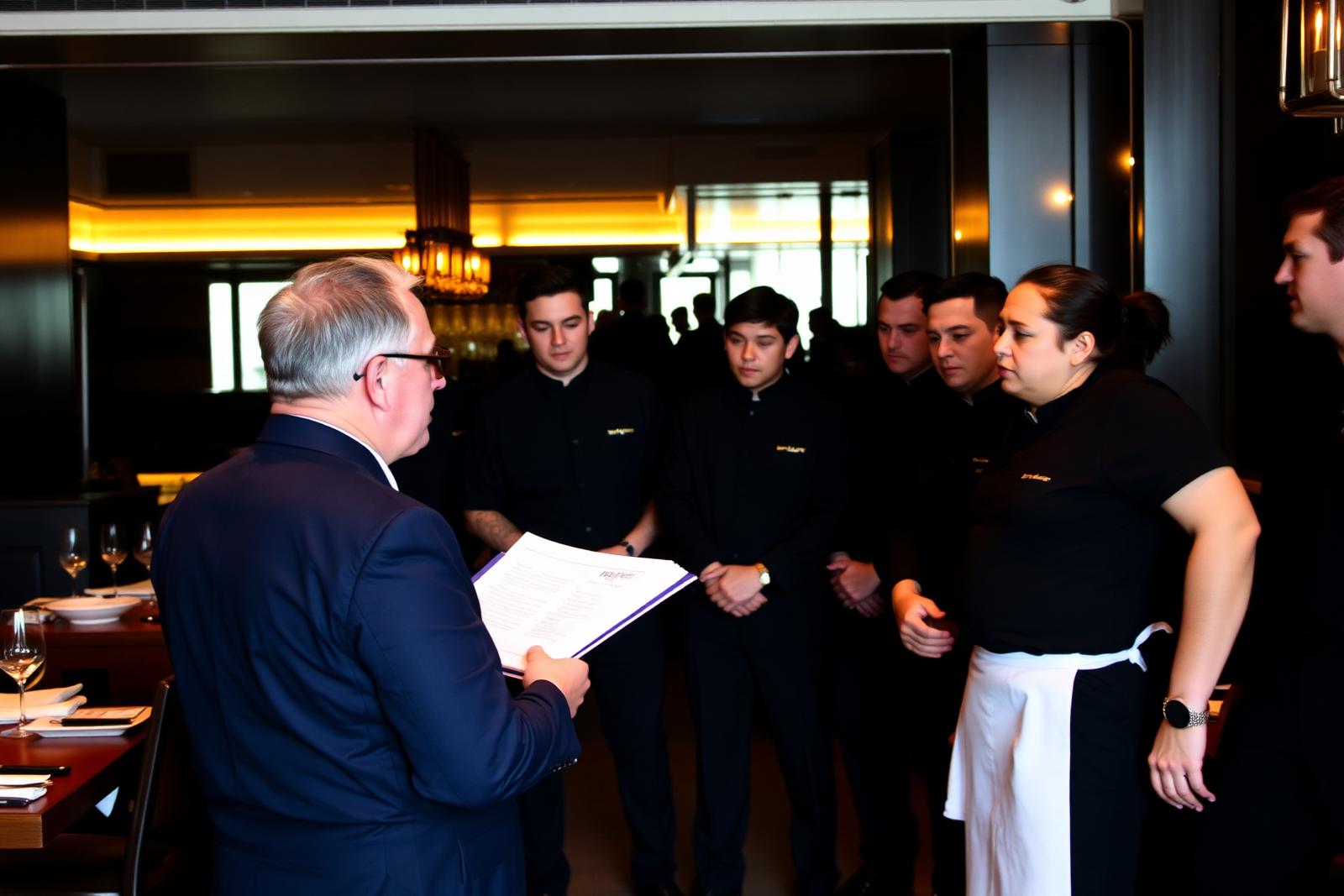
Training fails when the opening briefing discusses only reservations and unavailable items. Add one service behaviour to each briefing, demonstrated in less than five minutes. Before a busy Friday in Jubilee Hills, the focus might be table ownership and handovers. Before a corporate lunch in Nanakramguda, it might be identifying guests who need quick billing. Captains should observe that behaviour during service and give specific feedback after the rush, away from guests.
Use handovers to protect consistency across split shifts. The outgoing steward should identify ordered items, pending courses, guest requests, celebrations, billing instructions and any complaint already raised. The incoming steward then acknowledges the table rather than making guests explain everything again. Managers should review repeated failures weekly: if several stewards miss the same step, check whether the SOP, POS screen, table numbering or supervisor instruction is unclear before treating it as an individual performance issue.
Key takeaway
Document one outlet-specific service sequence, practise it through short scenarios and observe one measurable behaviour per shift. Consistency improves when stewards are coached on visible actions rather than vague expectations.
Need this handled?
Get single-window support for your outlet
Staffing, setup, procurement and operations — coordinated by one Hyderabad team.